JournalScent No. 03
Goose-Pear Canopy: the incense for inside the bed curtains
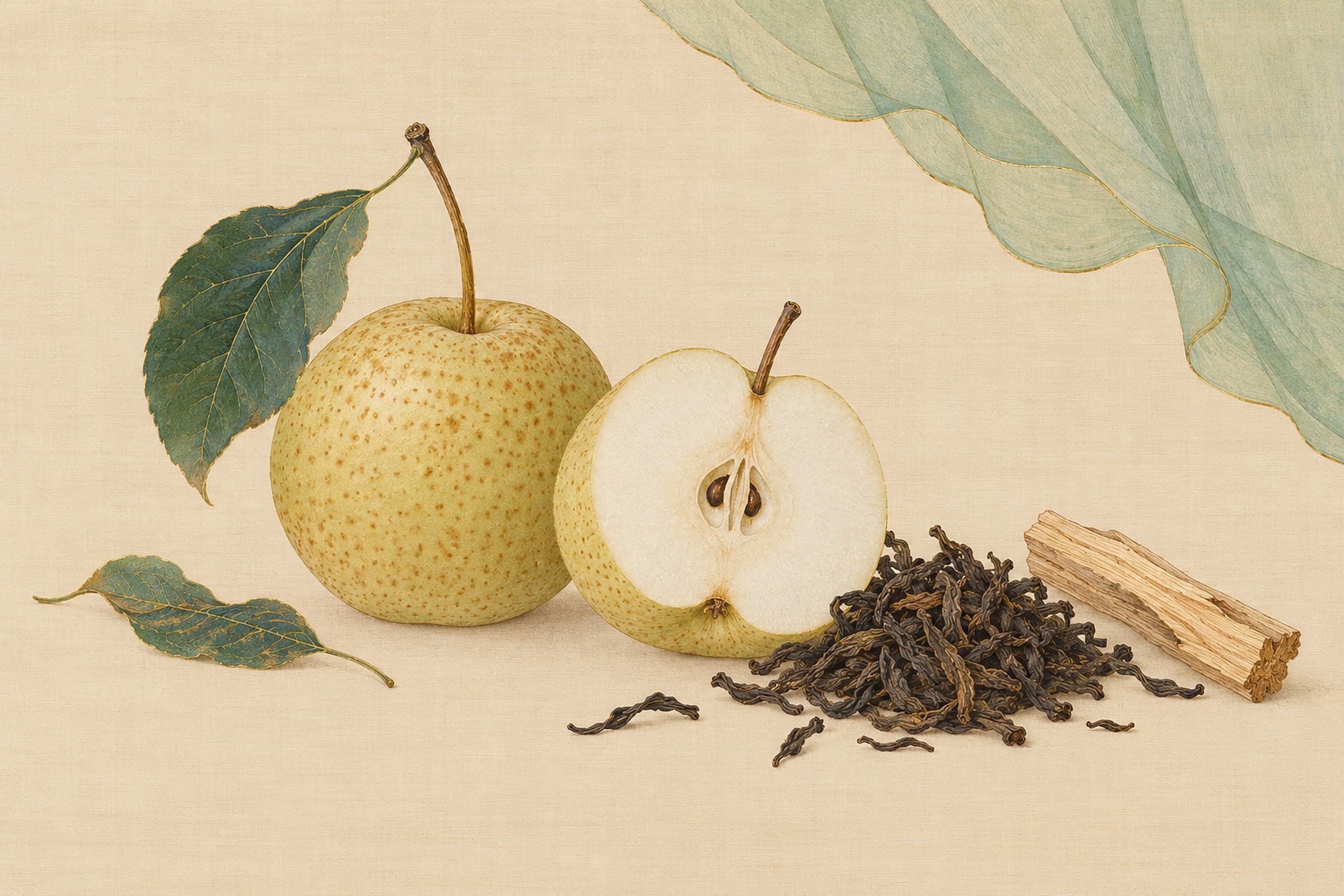
Crisp pear first, deepening into honeyed agarwood and creamy sandalwood. Goose-Pear Canopy, 鵝梨帳中香, is Scent No. 03 in our register, for long hours of reading or work. Its Chinese name means “goose-pear incense for inside the bed curtains”. In English it is often called goose pear tent incense.
The Southern Tang ruler’s incense
The Southern Tang was a kingdom on the lower Yangzi in the tenth century, remembered for the poetry and painting of its court. Hong Chu’s incense register, written in the Song dynasty, recorded one of its recipes. The original register is lost, but a Song commentary on Huang Tingjian’s poems quotes it:
The method for the bed-curtain incense of the ruler Li of Jiangnan: steam agarwood with goose-pear juice.
Goose pear, e li 鵝梨, is a fragrant, thin-skinned pear. The blend takes its name from where it was burned: inside the curtains of a bed.
Four recipes under one name
Chen’s Incense Register, finished by 1322, gives four versions of the same incense:
- Agarwood cut into small pieces and steeped in storax for a hundred days. “Better still with rose water.”
- A liang of agarwood (about forty grams) and the juice of ten goose pears, steamed three times in a silver vessel until the juice has gone.
- Goose pears hollowed out like little jars and filled with powdered agarwood and sandalwood. The tops go back on as lids. The pears are steamed three times, then peeled, and everything is ground together and left to mature.
- Agarwood, sandalwood, borneol, musk and a little saltpetre, bound with honey.
The third recipe uses three of the four materials in our blend: agarwood, sandalwood and goose pear. Ours uses an agarwood accord in place of the wood.
Huang Tingjian’s poems
Huang Tingjian (1045–1105) was one of the great poets of the Song. When someone sent him a gift of Jiangnan bed-curtain incense, he wrote two short poems in thanks. In one, the smoke is “a single plume of yellow cloud, winding round the desk”. His friend Su Shi wrote poems to match them, and Huang answered with two more.
Then someone smelled the incense and said it smelled like scorpions being fried. Huang wrote another two to the same rhymes. The first opens with an old story about a man by the sea who loved bad smells.
What is in it
Agarwood accord, sandalwood, goose pear, Pu’er tea leaves, listed from the largest amount to the smallest.
- Agarwood accord is a blended fragrance that recalls agarwood. It is not the wood itself.
- Sandalwood gives the creamy wood.
- Goose pear gives the crisp opening.
- Pu’er tea leaves come from the dark tea of Yunnan.
Our beads aren’t steamed in pear juice or packed into pears. The materials are powdered, blended and shaped into beads by hand, then dried for at least twenty days.
When to wear it
At the desk, over a long afternoon of reading or work.
See the entry: Goose-Pear Canopy · 鵝梨帳中香
Sources
- Hong Chu’s register, quoted in the commentary on Huang Tingjian’s poems: Shangu ji shi zhu 山谷集詩注, inner collection, volume 3 (有惠江南帳中香者戲答六言二首; 有聞帳中香以為熬蝎者戲用前韻二首).
- Chen Jing, Chenshi xiangpu 陳氏香譜, volume 2 (江南李主帳中香 and its three variants).