JournalScent No. 02
Jasmine Snowfall: the flower that came from the west
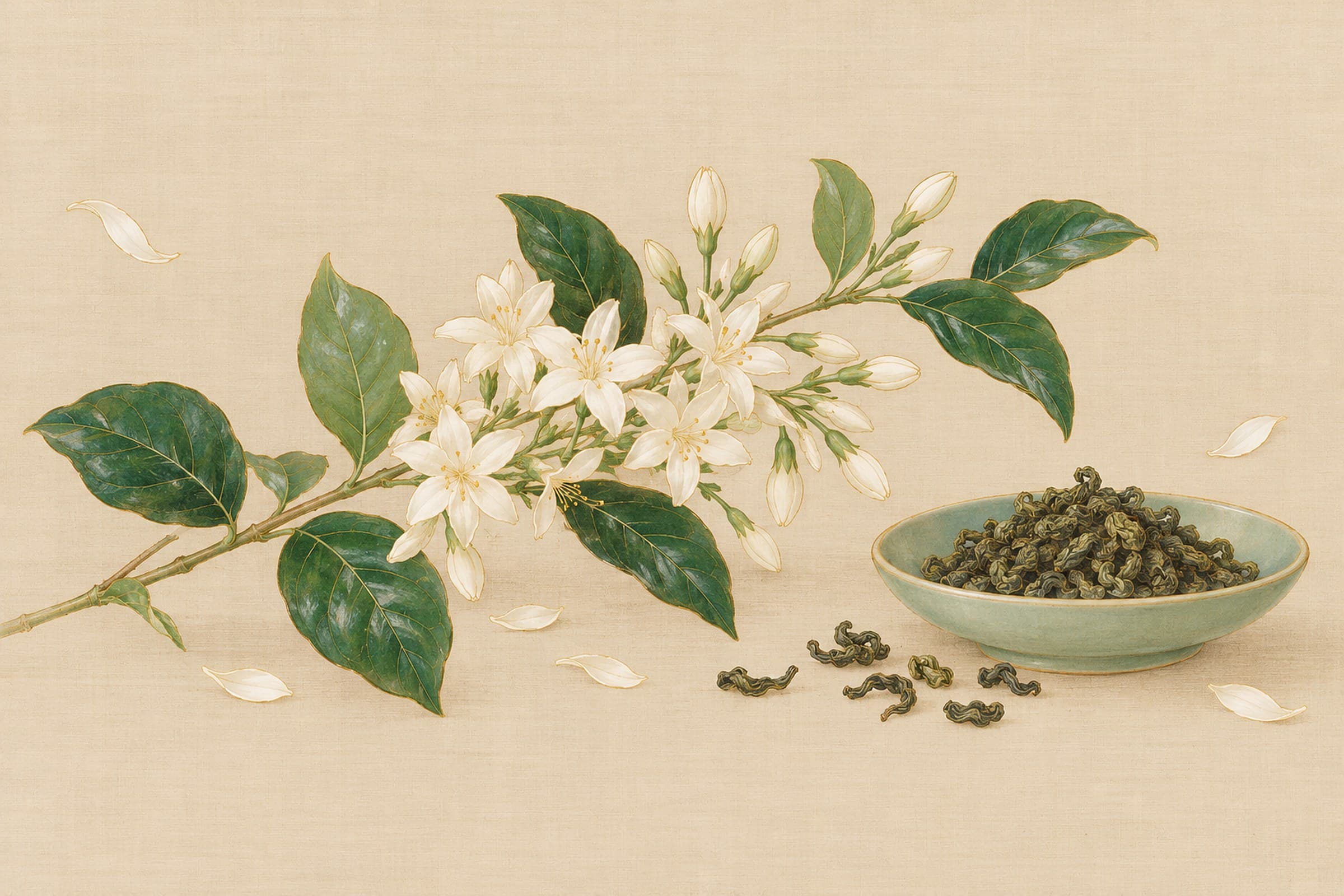
Small-flowered jasmine over a thread of tea, with sandalwood and agarwood beneath. Jasmine Snowfall, 茉莉吹雪香, is the lightest of our four formulas and a good first one. The supplier’s Chinese name reads “jasmine, blowing snow”.
Two foreign flowers
Moli 茉莉, the jasmine of Chinese tea and scent, isn’t native to China. Plants of the Southern Regions (南方草木狀), traditionally dated to 304, records it among the plants of the far south:
Yeximing and moli flowers were both brought by foreigners from the western lands and planted in Nanhai. The southerners loved their fragrance and raced to plant them.
It writes moli as 末利, where we now write 茉莉, and adds that the moli flower looks like a white rose and smells better than the yeximing.
Both names came from abroad as well. Yeximing is usually read as a transcription of the Persian yāsaman, the same word that became “jasmine” in European languages. Moli is read as the Sanskrit mallikā.
It then quotes an older travel account with a sharp opinion of the south. In that country, it says, the grains have no taste and the flowers have no scent. These two are the exception, because they came from somewhere else and did not change with the soil. And “the women there thread coloured silk through the hearts of the flowers, and wear them in their hair”.
Jasmine in the incense registers
In the incense registers, jasmine became a blending material. A note in Chen’s Incense Register, finished by 1322, says that “southern flowers can all be blended into incense”, and names moli first.
It also stood in for something rarer. The Song official Ye Tinggui writes that rose water came from the Arab world and seldom reached China, so people had begun steaming jasmine flowers and using the liquid instead. The register warns that much of this water was fake, and gives a test. Pour it into a glass bottle and shake it several times. If the bubbles rise and fall, it is real.
The register also gives a way to scent agarwood with fresh flowers, under the name of the Southern Tang ruler Li. Take tumi roses, osmanthus, orange blossom or Fujian jasmine, “picked with the dew still on them”, a bowl of them. Put them in a porcelain box, cover it with paper and steam it for the time it takes to eat a meal. Throw away the flowers and keep the liquid. Soak chopped agarwood in it and dry it in the sun, three times over, until the wood has drunk it all. “Some say none of this is as good as soaking it in rose water.”
Another note in the register, from a Wen Zipi, gives two tips. When picked jasmine flowers have just lost their scent, spray them with wine and it comes back. And through the year, steam each flower in its season: plum blossom, daphne, tumi rose, gardenia, jasmine, osmanthus, orange blossom. “When you burn it later, the scents of all the flowers are there.”
Scent without smoke
The poet Yang Wanli (1127–1206) describes an evening of incense. The censer is celadon “greener than water”; the incense sits on a leaf of silver “as thin as paper” over a fire that is neither fierce nor faint. The door is shut and the curtain down, so no wind stirs. He lights an old dragon-saliva incense and wants only this: “let there be scent, and no smoke to be seen”. Beside it he sets suxin about to open and jasmine just picked.
Jasmine in Hangzhou
By the Southern Song, jasmine had reached the capital at Hangzhou. Zhou Mi’s memoir of the city, written after the dynasty fell in 1279, shows it twice.
In the palace, the emperor escaped the summer heat in the Hall of Kingfisher Cold, among tall pines and a pool of lotus. In the wide courtyard stood hundreds of pots of southern flowers: jasmine, suxin, orchids from Fujian, musk vine, hibiscus and more. Fans turned by wheels blew across them, “and a clear fragrance filled the hall”. Behind the gauze screens hung scent beads of agarwood and of Cambodian dragon-saliva incense, “a hundred hu” of them, a measure used for grain.
In the city, on the sixth day of the sixth month, people took boats out on West Lake to escape the heat. Scent pouches, painted fans and pearl pendants were on sale, “but jasmine was the most popular of all. When it first comes out it is very dear. Women wear it in clusters, as many as seven sprigs, worth dozens of notes, for one afternoon’s pleasure.”
Two jasmines
The moli of south China and of jasmine tea is Jasminum sambac, called small-flowered or Arabian jasmine in English. Its flowers are small, white and often double, and they open in the evening. Suxin 素馨, its neighbour in the palace courtyard, is the name now given to Jasminum grandiflorum, the large-flowered jasmine with five open petals. Perfumers use both: grandiflorum, long grown around Grasse, and sambac, mostly from India.
Jasmine Snowfall uses small-flowered jasmine, the flower of jasmine tea, with a thread of dried tea beneath it.
What is in it
Small-flowered jasmine, agarwood accord, sandalwood, dried tea, listed from the largest amount to the smallest.
- Small-flowered jasmine is the top of the scent.
- Agarwood accord is a blended fragrance that recalls agarwood. It is not the wood itself.
- Sandalwood sits underneath.
- Dried tea gives the thread of tea under the flower.
The materials are powdered, blended and shaped into beads by hand, then dried for at least twenty days.
When to wear it
In the day, in warm weather, or as the first of the four if you haven’t worn scented beads before.
See the entry: Jasmine Snowfall · 茉莉吹雪香