JournalScent No. 01
Moonlit Osmanthus and the osmanthus month
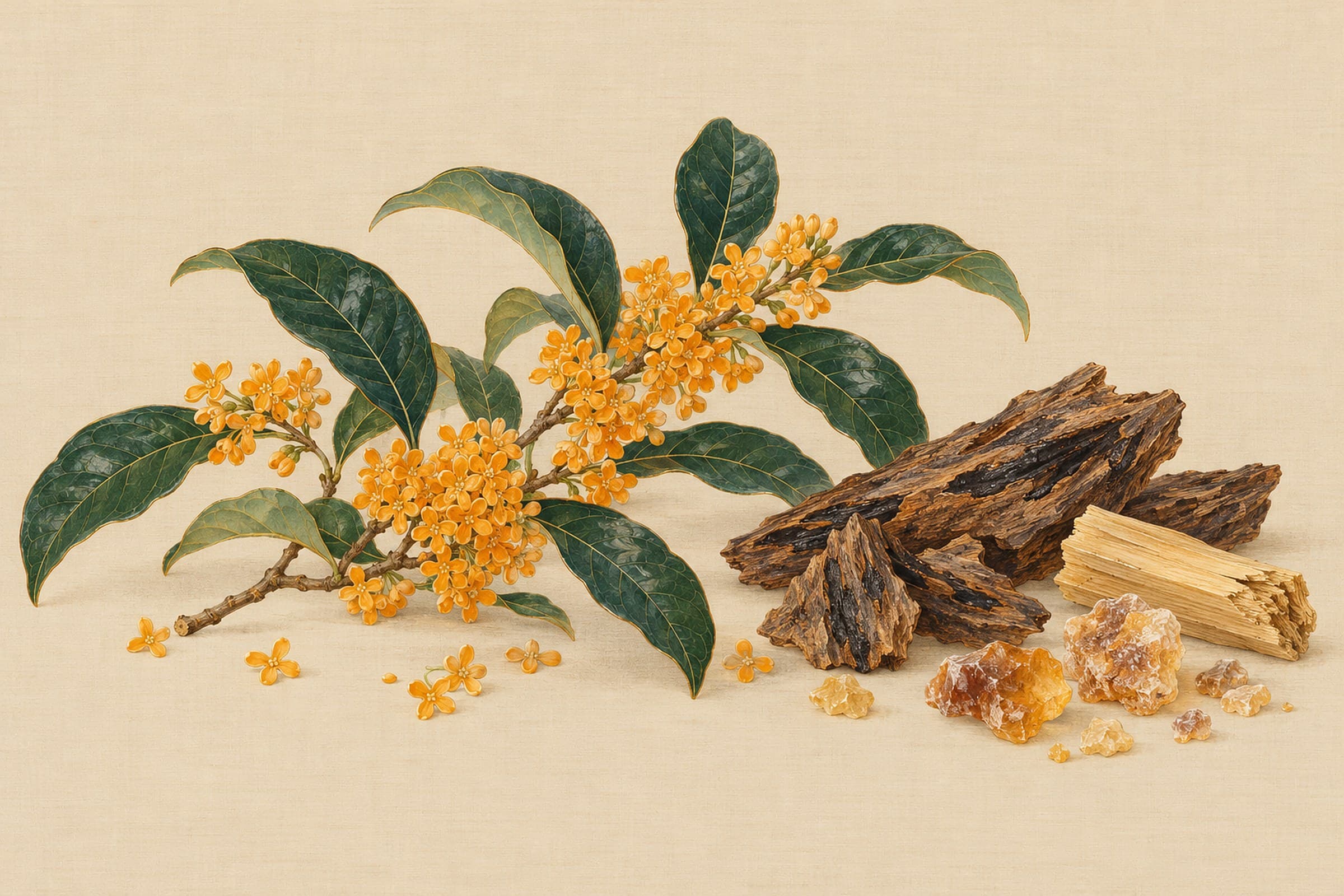
Sweet osmanthus first, then warm wood and the soft, vanilla-like resin of benzoin. Moonlit Osmanthus, 伴月木樨香, is Scent No. 01 in our register. It is a scent for autumn evenings.
Three names for one flower
In Chinese, osmanthus is guihua 桂花. The eighth lunar month, when it flowers, is named after it: guiyue 桂月, the osmanthus month.
Its other name, muxi 木犀, means “wood rhinoceros”. The Song writer Zhang Bangji explains why: in Zhejiang, people said the grain of its wood looked like rhinoceros horn.
Chen’s Incense Register, finished by 1322, adds a third name, yangui 巖桂, rock cassia, also called qilixiang 七里香, “seven-li fragrance”. The entry is short. Rock cassia grows in the valleys of Mount Lu and flowers in the eighth and ninth months, “and its scent fills the valleys. Picked and dried in the shade, it is remarkable in blended incense.”
Commissioner Sun’s osmanthus beads
The same register has a recipe for osmanthus beads, credited to a Commissioner Sun. It is precise about timing:
- Take the flowers in bud, before they open fully. “Once open, they have no scent.”
- Gather them before the dew has dried. Spread a cloth under the tree, or sweep the ground clean, and send someone up a ladder to shake the buds down.
- Pick out the stems and leaves. Grind the buds to a paste on a stone mill, wrap the paste in cloth and press out the water.
- Store the dried paste in a new porcelain jar. Take out a little at a time and grind it fine in a mortar.
- Shape the beads the size of a small coin, pierce each one with a bamboo skewer, and dry them in the shade beside the sun on four or five layers of paper.
- When they are a little firm, string a hundred to a cord and hang them from a small bamboo bow where the wind blows.
- At eight or nine parts dry, rinse them lightly, fifteen at a time, until they turn a blue-black colour. Dry them again in the shade.
- Wrap them in new silk floss and look at them from time to time. Kept this way, “the scent will last for years”.
Our beads aren’t made to Sun’s recipe, and they aren’t osmanthus alone. But they come out much the same colour: a cool, dark grey-brown with a fine grain and no shine.
What is in it
Golden osmanthus, agarwood accord, sandalwood, benzoin, listed from the largest amount to the smallest.
- Golden osmanthus gives the sweetness.
- Agarwood accord is a blended fragrance that recalls agarwood. It is not the wood itself.
- Sandalwood gives the warm wood underneath.
- Benzoin is a resin from styrax trees, with a soft smell close to vanilla.
The materials are powdered, blended and shaped into beads by hand, then dried for at least twenty days.
When to wear it
On an autumn evening, or any evening that feels like one.
See the entry: Moonlit Osmanthus · 伴月木樨香
Sources
- Zhang Bangji, Mozhuang manlu 墨莊漫錄, volume 8: “浙人曰木犀,以木紋理如犀也”. Quoted at China Writers.
- Chen Jing, Chenshi xiangpu 陳氏香譜, volume 1 (木犀香) and volume 4 (孫廉訪木犀香珠).