JournalScent No. 04
Elegant Orchid & Ambergris: dragon’s saliva, without the whale
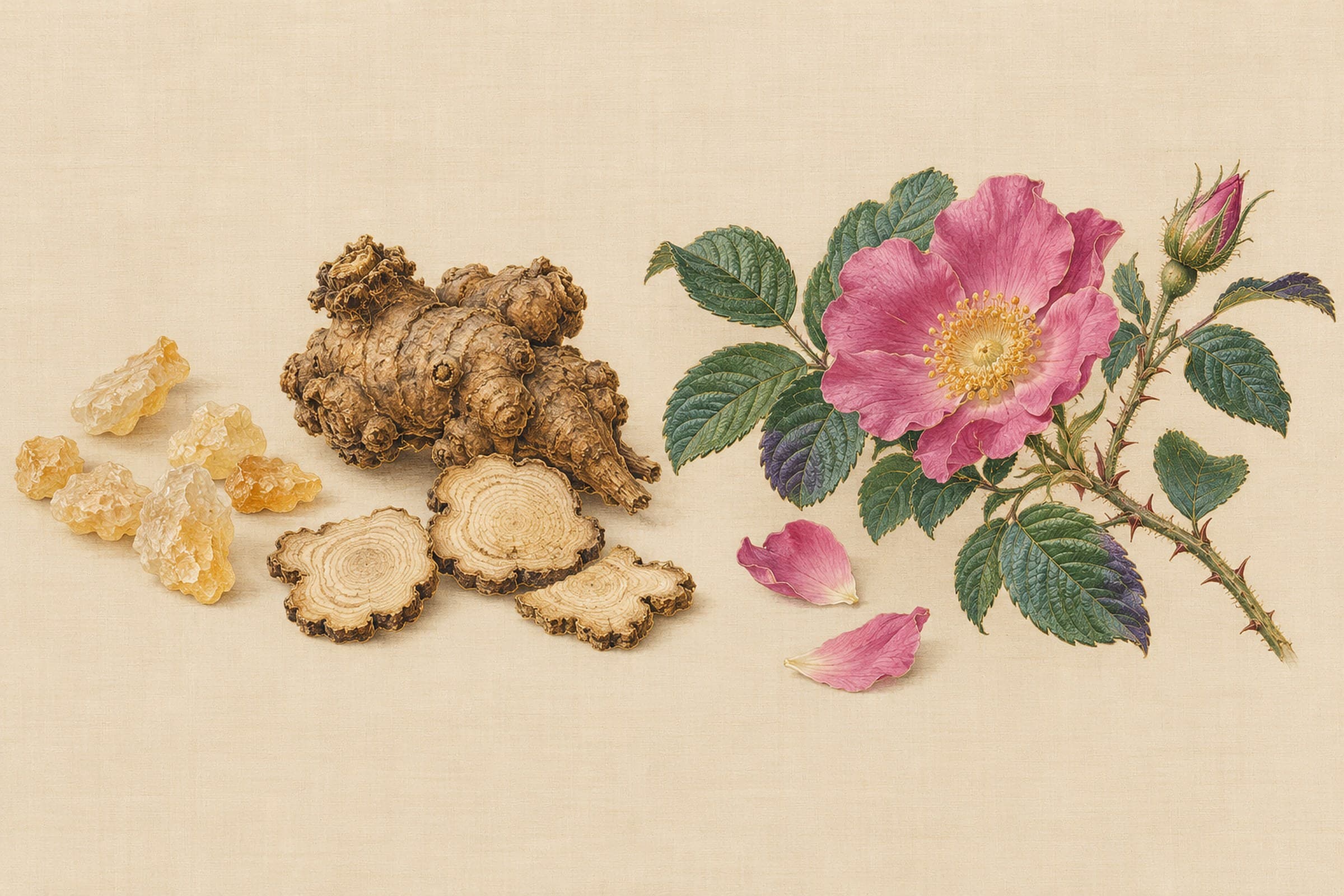
Warm and resinous: frankincense and agarwood, the green, rooty edge of chuanxiong, a little rose and a soft ambergris accord. Elegant Orchid & Ambergris, 蘭芳龍涎香, is Scent No. 04 in our register and the richest of the four.
Dragon’s saliva
Ambergris is longxian 龍涎 in Chinese: “dragon’s saliva”. The Song official Ye Tinggui, quoted in Chen’s Incense Register, explains the name. It comes from the Arab lands, where dragons coil on great rocks in the sea and drool as they lie there. The saliva floats on the water. Where strange birds circle and fish fight below them, the sailors know to collect it.
His description of the material itself is more down to earth. “Ambergris has no fragrance of its own. Its smell is close to rank.” The white kind is the best, smooth and fine-grained. The black kind is second best: it looks like dried flying-squirrel droppings, only glossier. Yet ambergris “brings out the other scents”, Ye says, “so it is much used in blending incense”.
Another writer in the register adds that a liang of ambergris cost as much as a liang of gold, and that a sailor who found some became very rich. A third gives a test. Burn it beside a cup of water. If the smoke goes down into the water, it is real.
Ambergris beads
Chen’s register, finished by 1322, includes a recipe for ambergris scented beads, 龍涎香珠. It lists nearly twenty materials, sandalwood and chuanxiong among them. Some are soaked in wine overnight and dried in the morning sun, then everything is rolled into beads. The ambergris goes in at the end, with borneol and musk.
Our blend shares two of those materials: sandalwood and chuanxiong.
Without the whale
Our ambergris is an accord: a blend of aromatic materials built to recall ambergris. So is our agarwood. Nothing in this blend comes from a whale.
Rose dew
Rose water came from the same direction. Ye Tinggui writes that it is the “flower dew” of the Arab lands. In the tenth century, he says, a foreign general named Puhesan presented fifteen bottles as tribute, and after that it hardly ever arrived. Another entry dates a gift of fifteen bottles to 958, “brought from the western regions”, and adds that clothes sprinkled with it wore out before the scent did.
No orchid
There is no orchid in the list. The orchid is the impression the blend leaves.
What is in it
Agarwood accord, sandalwood, frankincense, chuanxiong, rose dew, ambergris accord, listed from the largest amount to the smallest.
- Agarwood accord is a blended fragrance that recalls agarwood. It is not the wood itself.
- Sandalwood is the warm base.
- Frankincense is ruxiang 乳香 in Chinese, “milk incense”. The register says the clearest pieces were the best, and were called diru 滴乳, “dripped milk”.
- Chuanxiong is Sichuan lovage root, with a green, rooty smell.
- Rose dew gives a little rose.
- Ambergris accord gives the soft, warm finish.
The materials are powdered, blended and shaped into beads by hand, then dried for at least twenty days.
When to wear it
In the evening, or in the cold months, when you want the warmest of the four.
See the entry: Elegant Orchid & Ambergris · 蘭芳龍涎香
Sources
- Chen Jing, Chenshi xiangpu 陳氏香譜, volume 1 (龍涎香, 薔薇水, 乳香) and volume 4 (龍涎香珠).
- On black and white ambergris in Song poetry, see China Writers.