Hexiang: blended incense, worn as beads
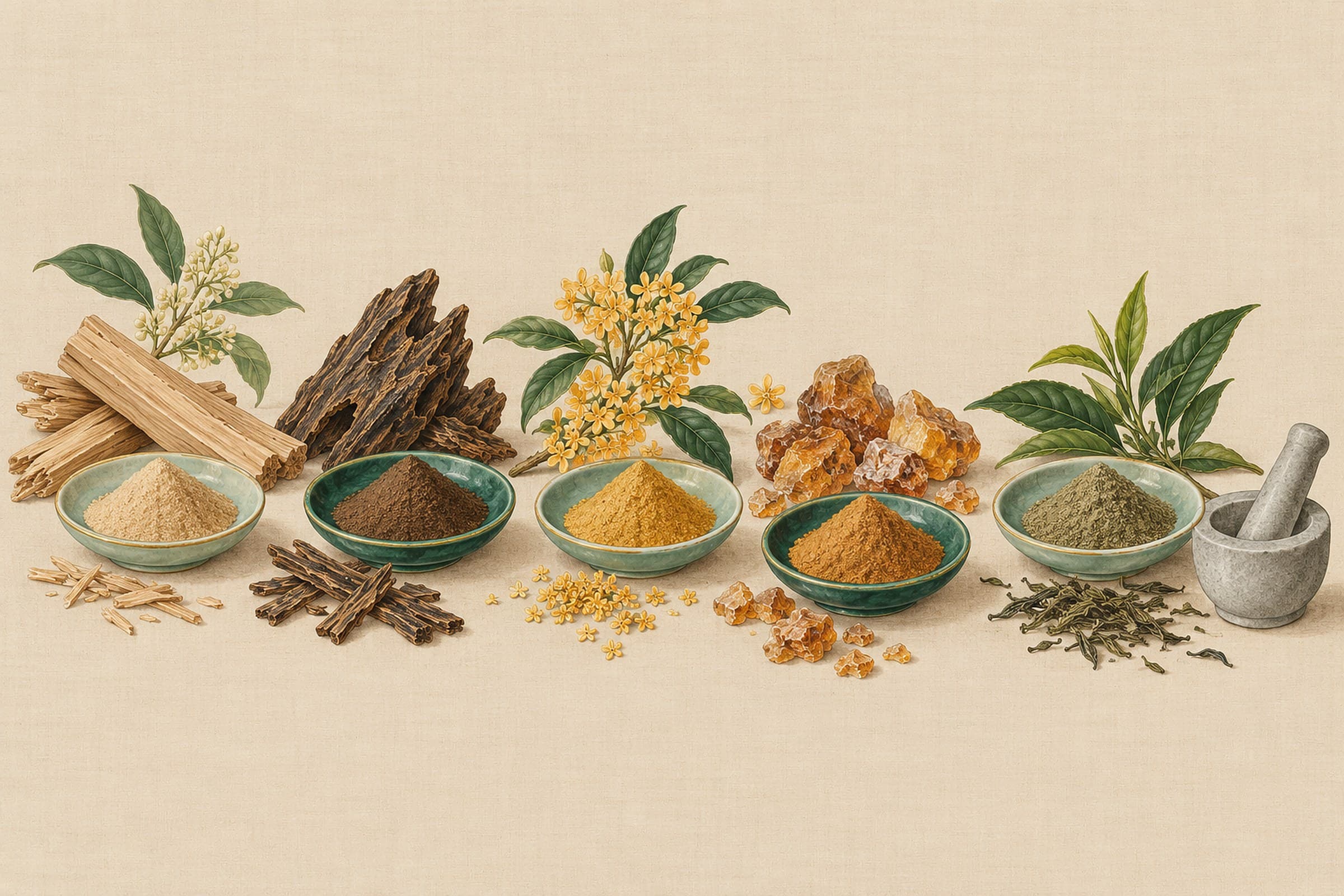
Hexiang 合香 means blended incense. You don’t burn one wood or one resin on its own. You powder several aromatic materials and combine them into a single scent. Every bracelet in our register is hexiang, shaped into beads.
Some to burn, some to wear
Chen’s Incense Register was compiled by Chen Jing and finished by his son. It has a preface dated 1322 and gathers eleven earlier incense registers into four volumes. Its first chapter sums up the subject in a few lines. Incense comes “from grasses or from trees, from flowers, fruit, joints, leaves, bark or sap, or it is made by hand, simmered and blended. Some is for burning, some for wearing.”
The register then quotes an older account of how the materials arrived. Before the Qin and Han dynasties, people spoke only of orchid, melilot, pepper and cassia. Under Emperor Wu of Han, court secretaries began to hold cloves in their mouths when they presented memorials to the throne. Later centuries brought agarwood, borneol and frankincense by sea. Rose water came too. In 958 a tribute mission presented fifteen bottles of it, brought from the far west, and clothes sprinkled with it wore out before the scent did.
Incense at the table
Wu Zimu’s memoir of Song-dynasty Hangzhou, the Mengliang lu, lists the offices a household could hire for a banquet. One of them handled incense: the ambergris, agarwood and borneol, the censers and the fine ash. Its staff also listened for the moment the incense needed changing, and after the wine they brought hangover soup. The memoir quotes a saying of the city: burning incense, making tea, hanging paintings and arranging flowers are four leisurely tasks, “not to be left to amateurs”.
Scent you carry
People wore scent as well as burning it. The 1322 preface to Chen’s register recalls two famous cases. When Xun Yu, a minister at the end of the Han, sat down in someone’s house, the seat stayed fragrant for three days. A Song scholar named Mei held his sleeves over a censer every morning, pinched them shut, and let the scent out once he had sat down.
The fourth volume of the register opens with scented beads, xiangzhu 香珠. Its first recipe, Commissioner Sun’s osmanthus beads, starts with the flowers still in bud (“once open, they have no scent”), gathered before the dew has dried. They are ground on a stone mill, pressed dry in cloth and rolled into beads the size of a small coin. Each bead is pierced with a bamboo skewer and dried in the shade on four or five layers of paper. Strung a hundred to a cord, they hang from a small bamboo bow in the wind. When they are nearly dry, they are rinsed fifteen at a time until they turn a blue-black colour. Wrapped in new silk floss, the recipe says, they keep their scent for years.
The same volume closes its bead recipes with care instructions for “scented rings, pendants and strings of beads”. After the summer, rub away the sweat and grime with horsetail, so the beads don’t spoil in the damp. If they have spoiled, wash them in warm water and dry them in the sun, “and the scent will be as before”.
How ours are made
Each of our formulas is powdered, blended and shaped into beads by hand, then dried for at least twenty days. We list the materials in order of quantity and say plainly which ones are accords. An accord is a blend of aromatic materials built to recall one smell. Our agarwood and ambergris are accords. Nothing in any of our blends comes from a whale.
Our beads aren’t made to the recipes above. We quote the registers because they show how long people have blended scent, worn it and looked after it.
Caring for ours
Keep them dry. Our beads are pressed powder, so take the bracelet off before washing your hands, bathing or swimming. The old advice to wash spoiled beads in warm water was for those beads, not ours.
The scent is clearest when a bracelet is new and softens as it is worn, but it stays for more than five years.
Not a diffuser bracelet
Scented beads are sometimes confused with lava-stone diffuser bracelets, which hold a few drops of essential oil. In hexiang beads, the aromatic materials are the bead itself. There is no oil to add.
The four formulas
- Moonlit Osmanthus · 伴月木樨香: golden osmanthus, agarwood accord, sandalwood, benzoin.
- Jasmine Snowfall · 茉莉吹雪香: small-flowered jasmine, agarwood accord, sandalwood, dried tea.
- Goose-Pear Canopy · 鵝梨帳中香: agarwood accord, sandalwood, goose pear, Pu’er tea leaves.
- Elegant Orchid & Ambergris · 蘭芳龍涎香: agarwood accord, sandalwood, frankincense, chuanxiong, rose dew, ambergris accord.
Sources
- Chen Jing, Chenshi xiangpu 陳氏香譜. Preface of 1322 and catalogue note; volume 1 (香品舉要, 薔薇水); volume 4 (香珠, 孫廉訪木犀香珠, 收香珠法).
- Wu Zimu, Mengliang lu 夢粱錄, volume 19 (四司六局筵會假賃).