Agarwood, oud and agarwood accord: what are you smelling?
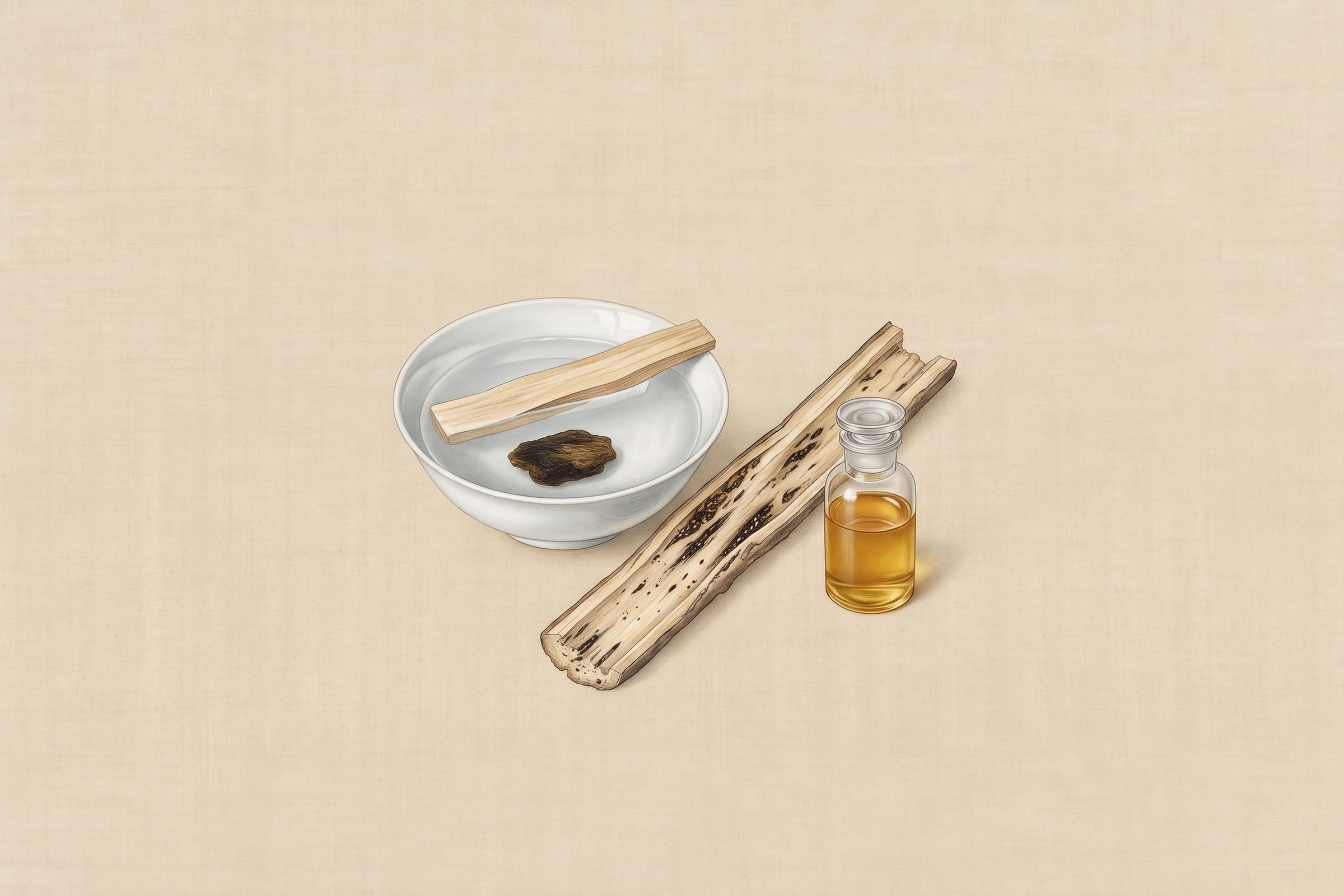
Warm, dark wood with a resinous sweetness underneath: in all four of our blends, that base is an agarwood accord, laid under real sandalwood. In Goose-Pear Canopy it turns honeyed under the pear. In Elegant Orchid & Ambergris it sits with frankincense and a little rose. Like the rest of the bead, it lasts for years.
It is not agarwood itself. Three words are used for this smell, often as if they meant the same thing. Agarwood is the wood. Oud is its Arabic name, used for both the wood and the oil distilled from it. An agarwood accord, or an oud accord, is a blend made to recall it. This is what each one is, and what the Song incense makers knew about the real thing a thousand years ago.
Agarwood: a wound in a tree
Agarwood comes from Aquilaria trees, and a healthy one has almost nothing to offer. Before it is infected, Wikipedia’s article says, its heartwood “mostly lacks scent, and is relatively light and pale in colouration”.
The change comes with damage. When a tree is wounded and a mould gets in, it fights back by secreting resin. As the resin builds up, the infected wood becomes “very dense, dark, and saturated with resin”, and that dark wood is agarwood. Only about seven in a hundred trees of the same species are infected.
Song writers knew both halves of this. The Juanyou lu, a Northern Song notebook quoted in Chen’s Incense Register, says agarwood trees grew thickly along the coast of Lingnan, the big ones as thick as a man’s arms can reach around:
The hill people use them for houses, for bridges and for rice steamers, but not one or two in a hundred has any scent. The wood forms scent only when water gets into it, mostly in broken branches and dead trunks.
And it tells how the hill people made it happen:
When they see a branch on a mountain tree that is bent or leaning, they cut a notch in it with a knife. After a year of rain soaking in, the scent forms. Then they saw it out and scrape away the white wood, and the scent is left in speckles. This is also called partridge-speckled.
Modern plantations do the same with more method. A common practice is to inoculate the trees with the fungus, and many techniques have been tried, “with varying degrees of success”.
Sinking incense
The Chinese name is chenxiang 沉香, “sinking incense”. Chen’s register gives the reason from the History of the Southern Dynasties: “put in water, it sinks, so it is called sinking incense. Pieces that float are zhan incense.” Resin is heavier than wood, so the more resin, the lower it sits.
One tree, the Song writers said, gave three grades: chen, which sinks; zhan, which floats; and huangshu, “yellow-ripe”, light and crumbly. Chen Zhengmin described the layers in a single piece: “on the outside, plain white wood; next, zhan; at the centre, chen”. The register lists many more names: chicken-bone for pieces shaped like one, green cassia for resin formed under the bark of thin branches, dragon-scale for thin flakes.
What a Song buyer smelled
Ye Tinggui, a Song official who wrote about the incense that came through the southern ports, ranked agarwood by where it came from: Zhenla, in today’s Cambodia, first, Champa second, Boni on Borneo last. More is in Agarwood accord, the first entry of our materials register. He also gave three rules. Agarwood formed in a living tree is better than agarwood from a tree that has fallen and rotted. Hard and black is better than yellow. And the shapes it was named for, rhinoceros horn, swallow’s beak, aconite root or weaver’s shuttle, mean nothing: “on the whole it is judged by where it comes from, its scent and its colour, and its shape does not decide which is better”.
He describes the difference he smelled. The agarwood of Hainan, called Penglai incense, “has a scent that is clear and long”. So little of it reached the merchant ships that it often cost twice as much as agarwood from Zhenla. The incense of Boni and Srivijaya “is coarse and fierce”, and cost a third as much. Of another kind, su incense, he says that a piece cut from a living tree keeps its scent long, while one left to rot where the tree fell “scorches easily”.
Fan Chengda, governing the far south in 1175, put Hainan agarwood more warmly: a scent “like lotus, plum blossom, goose pear and honeycomb”. His account is in The Song incense registers.
The register also says how agarwood was prepared for blending. Chop it fine, put it in a silk bag, and hang the bag in a pot so it does not touch the bottom. Simmer it in honey water for a day, adding water as it boils away. Then it adds: “today it is mostly used raw”.
Fakes and forcing
Where something is costly, someone will cheat, and Song buyers knew it. Ye Tinggui describes a cheap kind from Champa called Wuli incense. The local people cut the trees, split them, and “dry them over a fire so that the resin shows on the outside”, to pay their taxes. Merchants then carved the resin out. He ranks it below the others.
Another kind, zan incense, was only half formed, with half its wood still there. “Merchants cut the wood away with a knife, pick the finest pieces and mix them in with su incense to sell, so that buyers cannot tell.” Ding Wei, banished to Hainan in the 1020s, was pleased that in the villages there “not one piece in ten was fake”. Fan Chengda, a century and a half later, wrote that when coastal traders sorted a load bought from the hills, not one or two parts in ten were true agarwood.
Oud
In Arabic both the wood and the oil distilled from it are called oud, عود, literally a rod or stick. The oil is made by steam distillation, and the yield is tiny: 70 kilograms of wood gives no more than 20 millilitres. Burned as chips, it has long been used in mosques, and it is one of the reasons the Arab world built trade routes in ancient times.
First-grade agarwood is one of the most expensive natural raw materials in the world. That is why many perfumes named for oud are built on an accord. Wikipedia’s article on agarwood puts it plainly: most brands have a creation based on oud, or on “an accord of oud created through the use of certain chemical scent components”. Few perfume houses use real oud, “because oud is very expensive and potent”. It adds that oud is generally a base note, and is traditionally paired with rose, as our agarwood accord is in Elegant Orchid & Ambergris.
So when a perfume says oud, it may contain oud oil, an oud accord, or both. The label or the maker should say which.
Our agarwood accord
Ours is an accord: a blended fragrance that recalls agarwood. It is not the wood, and it is not oud oil. We list it as “agarwood accord” wherever our materials appear.
We have three reasons. The first is the trees. Since 1995, Aquilaria malaccensis, the main source of agarwood, has been listed in Appendix II of CITES, the convention on trade in endangered species, and since 2004 every Aquilaria species has been. Aquilaria malaccensis is now critically endangered on the IUCN Red List. Real agarwood crossing a border needs permits, and overharvesting still threatens wild trees. The second is the price, which would put a string of beads beyond reason. The third is that an accord smells the same from one batch to the next, where natural agarwood varies with every tree.
Two of the twelve materials in our beads are accords, agarwood and ambergris. The other ten are the materials themselves: sandalwood, golden osmanthus, benzoin, frankincense and the rest. What an accord is, and how old the idea is, is in What is an accord in perfume?
How to tell what you are smelling
- “Agarwood accord” or “oud accord” means a blend made to recall agarwood. It can be good, but it is not the wood.
- “Oud” on a perfume can mean oil, accord or a mix. Ask, or read the ingredient list.
- Agarwood chips or oil sold across borders should come with CITES paperwork. If the seller cannot say where it was grown and whether it is cultivated, be careful.
- Real agarwood chips are warmed, not set alight. The Song laid them on a thin leaf of mica or silver over a buried ember, as described in How the Song burned incense.
Questions
Is agarwood the same as oud? Yes and no. Oud is the Arabic name for agarwood and for its oil. In perfume, “oud” often means an oud accord.
Is the agarwood in your beads real? No. It is an agarwood accord, a blended fragrance that recalls agarwood. It is not the wood itself. Our sandalwood is real.
Why is real agarwood so expensive? Only a small share of trees ever form it, it takes years, wild trees are protected, and the oil yield is tiny: no more than 20 millilitres from 70 kilograms of wood.
Is agarwood endangered? Every Aquilaria species has been in CITES Appendix II since 2004, and Aquilaria malaccensis is critically endangered on the IUCN Red List. Plantations now grow and inoculate trees.
What does agarwood smell like? The Song writers called the best “clear and long”, and Fan Chengda heard lotus, plum blossom, goose pear and honeycomb in it. Lesser kinds they called coarse and fierce. Our accord aims at the warm, sweet, woody side.
Is agarwood the same as sandalwood? No. They come from different trees. Sandalwood is the heartwood of Santalum trees, fragrant in its own right. Our beads use real sandalwood powder.
How long does the scent of a bead last? For years. Keep the beads dry: take the bracelet off before washing your hands, bathing or swimming.
What our beads are made of: the materials register
Sources
- Chen Jing, Chenshi xiangpu 陳氏香譜, volume 1 (沉水香, quoting the 南史, 談苑, 倦遊錄, 陳正敏 and 葉庭珪; 生沉香; 蕃香; 棧香; 黄熟香; 生熟速香; 暫香; 烏里香; 沉香, on preparation).
- Fan Chengda, Guihai yuheng zhi 桂海虞衡志, 志香 (1175).
- Ding Wei, Tianxiang zhuan 天香傳, in the Xiangpu printed under Hong Chu’s name, Wikisource.
- Wikipedia, Agarwood and Aquilaria malaccensis.