What is an accord in perfume? From plum blossom to chypre
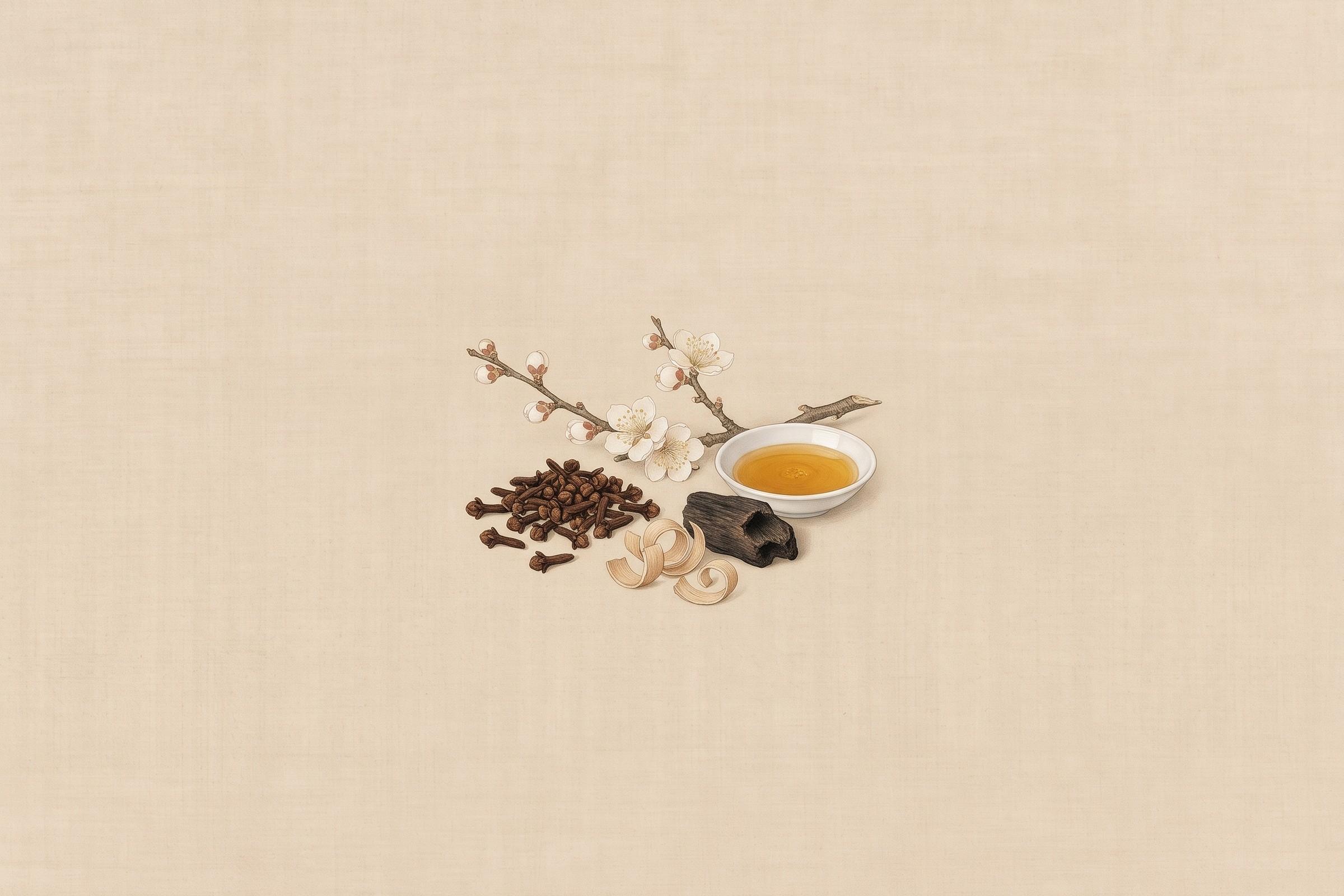
An accord is a few aromatic materials blended until they smell like one thing, and often like something that is not in the blend at all. Two of the twelve materials in our beads are accords. The agarwood accord is the warm wood under all four blends. The ambergris accord in Elegant Orchid & Ambergris is a soft warmth, a little sweet and a little salty, closer to skin than to flowers. Like the rest of the bead, they last for years.
The idea is much older than the word. Chen’s Incense Register, finished by 1322, has ten recipes named for plum blossom, and not one of them lists plum blossom.
Where the word comes from
Accord is French for a chord in music: several notes played together that the ear hears as one sound. Perfumers took their vocabulary from music in the nineteenth century. In 1855 the London perfumer and chemist Septimus Piesse wrote in The Art of Perfumery that “scents, like sounds, appear to influence the olfactory nerve in certain definite degrees. There is, as it were, an octave of odours like an octave in music.” Almond, heliotrope, vanilla and orange blossom, he wrote, blend together like the keys of one octave. Citron, lemon, orange peel and verbena make a higher one.
He also saw what blending could do. “From the odours already known we may produce, by uniting them in proper proportion, the smell of almost any flower, except jasmine.” Sweet pea, he noted, was rarely extracted, because a very close imitation could be made from extracts of tuberose, orange blossom and rose with a little vanilla. That imitation is an accord in all but name. He made an exception of jasmine, and our Jasmine Snowfall uses the flower itself, small-flowered jasmine, dried and powdered.
The musical words stayed. A note is one impression you notice in a scent, such as the crisp pear at the start of Goose-Pear Canopy. An accord is the group of materials built to give one impression.
How an accord is made
The French perfumer Jean Carles, who founded the Roure perfumery school in Grasse in 1946, taught a patient way to build one. Take two materials and blend them in a series of proportions: one part oakmoss to nine of patchouli, then two to eight, three to seven, and so on up to nine to one. Smell them all and keep the best. Then test that blend in the same way against a third material, such as vetiver. A perfume made like this grows in steps, from accords that have each been tried, instead of all at once.
Accords that became families
Some accords outgrew the perfume they were made for. In 1882 Paul Parquet, the owner of the house of Houbigant, made Fougère Royale from lavender, oakmoss and coumarin, a compound with the sweet smell of new-mown hay that had first been made in a laboratory in 1868. Fougère is French for fern. There is no fern in it, and the name now covers a whole family of perfumes, many of them made for men.
In 1917 François Coty made Chypre, French for Cyprus, around bergamot, labdanum and oakmoss. Perfumes in a similar style existed before it, but Coty’s was the first built on that accord, and the perfumes that followed it are still called chypres.
Plum blossom with no plum in it
Song incense makers worked the same way, centuries earlier. The second volume of Chen’s Incense Register has ten recipes named for plum blossom. None lists the blossom. A few call for salted plums, the fruit. The rest are built from cloves, sandalwood, agarwood, spikenard and lingling herb, with a little borneol and musk, bound with honey. One, the register adds, is “especially good to wear”.
Another, called One Branch, is set out as a rhyme so that it could be remembered:
Agarwood and sandalwood, a measure each; of cloves, half that. Five liang of charcoal ash, sifted through silk. Roll pills in refined honey, add borneol and musk to burn, and the east wind blows ten branches of plum into flower.
The orchid that beats the orchid
The third volume does the same for orchids. A run of eleven recipes is named for them: Smiling Orchid 笑蘭, Like Orchid 肖蘭, Better than Orchid 勝蘭 and others. None lists an orchid. Better than Orchid is another rhyme:
Snail lid, a measure, boiled three times; two liang of dark agarwood, three of sandalwood; water musk, one qian, and borneol, a half: a rare scent, clear and gentle, better than the fragrant orchid.
The snail lid, jiaxiang 甲香, is the lid that closes a sea snail’s shell. Water musk was a liquid musk, told of in Musk accord vs real musk. One more orchid recipe binds its powder with the juice of steamed goose pears, the pear described in What is a goose pear?.
Our own Elegant Orchid & Ambergris belongs to this family. There is no orchid in its list either. The orchid is the impression the blend leaves.
Osmanthus, with and without the flower
The register does not always imitate. Most of its osmanthus recipes use the flowers, and they are particular about them: pick the buds before sunrise, with the dew still on them, when they are three or four tenths open, because “once the flowers open fully, there is no scent”. But two osmanthus recipes in the same run use no osmanthus at all. One is a fragrant heartwood, jiangzhen 降真, steeped with tea in the juice of goose pears and mixed with powdered sandalwood. Our Moonlit Osmanthus takes the first road: golden osmanthus, the flower itself.
The register’s scents for clothes and for wearing do the same. A rose scent for clothes has no rose in it. A peony scent with no peony flowers and a lotus scent that smells “like a lotus just opened” were carried against the skin; more on them in Did people in ancient China wear scent?
Why use an accord
Some materials can’t be had, or shouldn’t be. Real musk comes from a protected deer, and real ambergris cannot be sold in the United States. There is more in Musk accord vs real musk and Dragon’s saliva incense. Some will not give up their scent, like Piesse’s sweet pea. And an accord smells the same from one batch to the next, where natural materials vary.
Sometimes the accord is the whole point. Chypre and fougère are not copies of anything. They are scents someone imagined and then built. Even the Song plum blossom is less a copy than a picture: its rhyme ends with the east wind and ten branches in flower.
For us the reasons are simple. Nothing in our beads comes from a whale. The scent holds from one batch to the next. And the beads can be sent to every country we ship to.
Questions
Is an accord natural or synthetic? It can be either. The word says what a blend does, not what it is made of. A Song plum-blossom incense was woods, spices, honey and musk. A modern ambergris accord is mostly made in a laboratory, and ours is synthetic. Our agarwood accord is a blended fragrance that recalls agarwood. It is not the wood itself.
Is an accord fake? It is not the material it is named for, and it should say so. Ours are listed as accords wherever our ingredients appear. But calling an accord fake misses what it is for. Chypre was never made from Cyprus.
What is the difference between a note and an accord? A note is one impression you notice: the pear at the start of Goose-Pear Canopy, the sandalwood underneath. An accord is a group of materials built to give one impression. A single material can make a note. An accord always takes several.
Which of your materials are accords? Two of the twelve: agarwood and ambergris. The other ten are the materials themselves: sandalwood, golden osmanthus, benzoin, small-flowered jasmine, dried tea, goose pear, Pu’er tea leaves, frankincense, chuanxiong and rose dew.
How long does the scent of a bead last? For years. Keep the beads dry: take the bracelet off before washing your hands, bathing or swimming.
What our beads are made of: the materials register
Sources
- Chen Jing, Chenshi xiangpu 陳氏香譜, volume 1 (甲香), volume 2 (梅花香, 梅英香, 梅蘂香) and volume 3 (笑蘭香, 肖蘭香, 勝蘭香, 蘭蕋香, 木犀香, 薔薇衣香, 牡丹衣香, 芙蕖香).
- G. W. Septimus Piesse, The Art of Perfumery, London: Longman, Brown, Green, and Longmans, 1855, pp. 62–63, Internet Archive.
- Wikipedia, Jean Carles, Fougère and Chypre.