Musk accord vs real musk: from the deer to the molecule
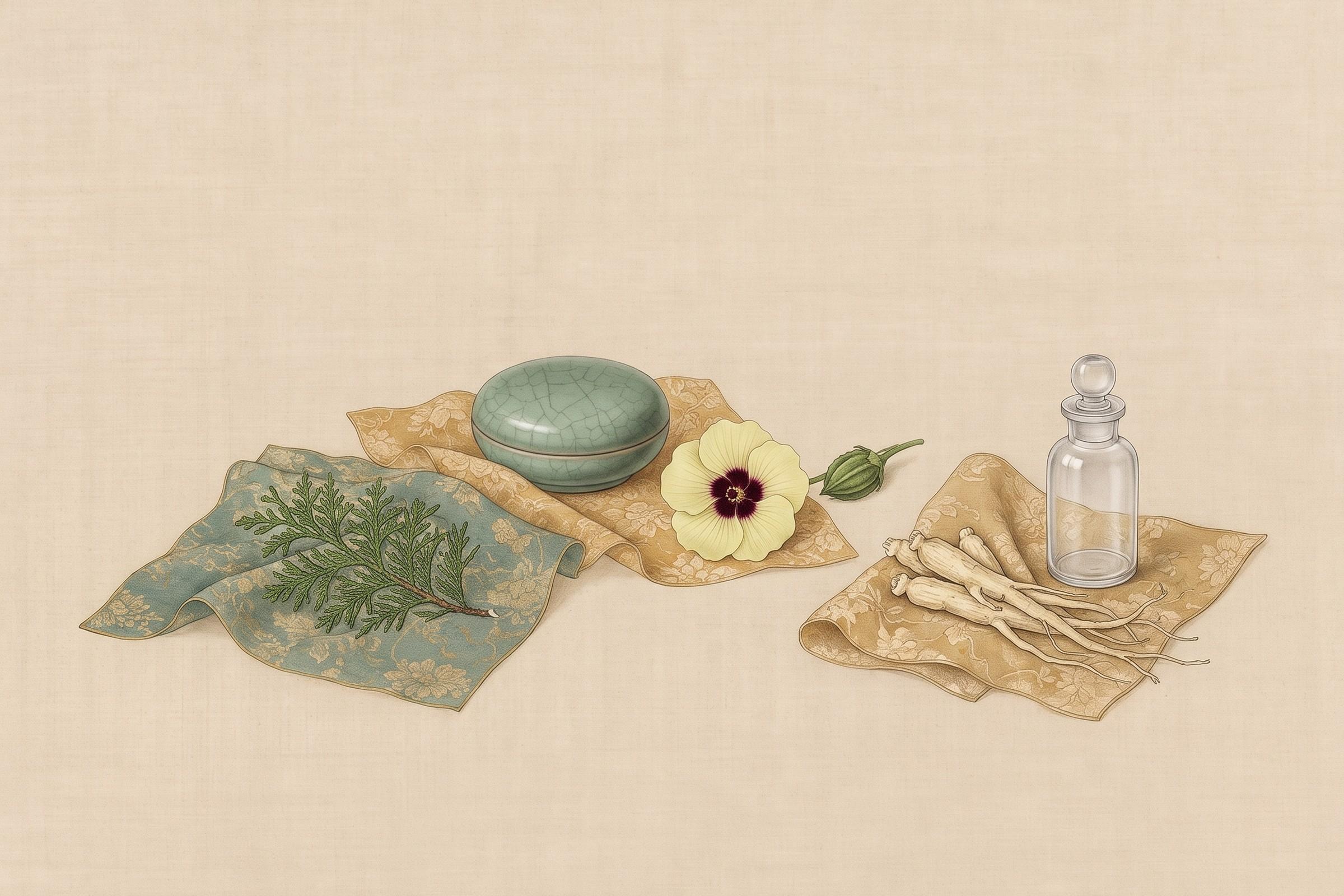
A musk accord smells soft, warm and clean: a little powdery, a little sweet, closer to warm skin or washed cotton than to any flower. It sits low in a blend, under the woods and resins, and it is one of the slowest parts of a scent to fade. A scented bead holds its blend for years, and nothing in ours comes from a musk deer.
Real musk does. Shexiang 麝香, “musk deer scent”, is the dried secretion of a gland of the male musk deer, and for well over a thousand years Chinese incense makers used a little of it in almost every fine blend. Today the deer is protected almost everywhere it lives, and the musk in perfume is made, not taken.
Where real musk comes from
Musk deer are small, shy deer of the mountain forests of China, the Himalaya and Siberia. They have no antlers; the males have long upper tusks instead. Under the skin of a male’s belly is a pouch, the musk pod, and inside it a secretion dries into dark grains. Raw, it is strong and animal. Dried and much diluted, it turns warm and sweet and lasts a long time. The English word comes, by way of Greek and the Persian mushk, from a Sanskrit word for testicle, which is what the pod was thought to look like.
What Song writers knew
Chen’s Incense Register, finished by 1322, collects what earlier writers had said about musk. It quotes Tao Hongjing (456–536), who wrote that the musk deer looks like a river deer and eats cypress leaves and snakes, so that musk taken in the fifth month often has snake bones in it.
Tao also knew the fakes. Often, he wrote, a single true grain, the one “by the door”, was kneaded into three or four and padded out with scraped membrane and other matter. The safest buy was a pod still closed, with its skin and hair. Best of all was musk the deer had scraped out itself. After a summer of eating snakes and insects the pod is full by the cold season, Tao wrote, and in spring it pains the animal until it digs the musk out with its own foot. Whoever found that had musk “far better” than any other.
A Northern Song notebook quoted in the same entry, the Juanyou lu, says that the musk deer of the Shang and Ru mountains always left their droppings in one spot. However far they went to feed, they came back to it, “not daring to leave a trace elsewhere for fear of being caught”. Hunters used exactly that to find them, and took the whole herd. The notebook adds a story the register repeats: the musk deer loves its pod so much that, when it is chased to a cliff, it throws itself off and tears the pod open with its claws, and when it is caught and dying, it still holds its four legs over its navel. It is a legend, not natural history, but it shows how hard the animal was hunted for one small gland.
From Hong’s earlier register, Chen also copies a Tang story about “water musk”. In the Tianbao years (742–756), a pod found around Guangzhou held musk that was entirely liquid. It was drawn out with a needle and smelled twice as strong as the ordinary kind.
Musk in the recipes
Song recipes use musk by the pinch. A typical blend in the register asks for a liang or more each of agarwood and sandalwood, a liang being about 40 grams, and a few qian of musk, a tenth of a liang each. The fifth-century historian Fan Ye had already warned that “musk has many dangers, and too much of it does harm”; his short essay on blending is in What is hexiang?.
The handling was careful. Recipe after recipe tells the maker to grind musk and borneol “in a separate vessel”, never pounded with the rest. In several, the honeyed paste is first stored in a jar in a cellar for a month, and the borneol and musk are worked in only when the pills are rolled. One recipe dissolves its pinch of musk in clear tea before adding it. Musk “fears heat”, the register’s notes on storing incense say, so it was kept apart and added last.
Why real musk is nearly gone
Only the male has a pod, and for centuries the usual way to get one was to kill the deer. Wild musk deer in China fell from about 2.5 million in the 1950s to about 66,300 in 2000, according to a 2019 study. Every species of musk deer is now first-class protected wildlife in China. Under CITES, the convention on trade in endangered species, commercial trade in musk deer from Afghanistan, Bhutan, India, Myanmar, Nepal and Pakistan is banned, and trade from anywhere else needs a permit.
China began farming musk deer in 1958, and on farms musk can be taken from living males. Even so, nearly all the musk in perfume today is synthetic.
From deer to molecule
The first synthetic musk was an accident. In 1888 the German chemist Albert Baur was trying to make a more effective form of TNT and made a compound that smelled of musk. Other “nitro musks” followed and were used for decades; they have since largely been replaced.
The molecule that carries most of the smell of deer musk was isolated and named muscone in 1906. In 1926 Leopold Ružička worked out its shape, a ring of fifteen carbon atoms, and made a little of it in the laboratory. His work on large rings of this kind was part of what won him a share of the 1939 Nobel Prize in Chemistry. Muscone and its relatives, the macrocyclic musks, come closest to the scent of the deer, but they were hard and costly to make and only came into common use decades later. Meanwhile a third family, the polycyclic musks, gave the clean, laundry-like musks of the late twentieth century.
Plants have musks too. Ambrette seed, from a relative of the hibiscus, and angelica root both contain ring-shaped molecules that smell of musk.
What a musk accord is
An accord is a blend of aromatic materials built to recall something it does not contain; there is more on the idea in Dragon’s saliva incense. A musk accord brings together several synthetic musks, sometimes with a plant musk, to give the warmth, softness and staying power that deer musk once gave a blend.
Using several is partly practical, because people smell musks very differently. In a 1996 study at a fragrance house, 32 people were tested on eleven different musks. Twelve were sensitive to all of them and sixteen to none of them in particular. The last four were insensitive to most, but unusually sensitive to one or two. A blend of musks is more likely to reach every nose.
Questions
Does your bracelet contain real musk? No. Nothing in our beads comes from a musk deer.
Is a musk accord fake musk? It is not deer musk. But some synthetic musks are the very molecule that carries the smell of deer musk, made in a laboratory instead of a gland; others are cousins with a different shape and a similar smell.
Why can’t I smell musk in some perfumes? Many people can’t smell one musk or another. It is common and harmless, and it is one reason the same perfume can seem to vanish on one person and linger on another.
What did Song musk incense smell like? We can’t know exactly. The recipes survive, and some descriptions of the smoke, but not the materials. Many old recipes call for real musk, real ambergris or wild agarwood, now protected or restricted. More on what survives in Song dynasty incense registers.
How long does the scent of a bead last? For years. Keep the beads dry: take the bracelet off before washing your hands, bathing or swimming.
What our beads are made of: the materials register
Sources
- Chen Jing, Chenshi xiangpu 陳氏香譜, volume 1 (麝香, quoting Tao Hongjing, Hong’s register and the Juanyou lu 倦遊錄; 合香 and 收香 notes) and volume 2 (recipes: musk ground in a separate vessel, added when the pills are rolled, dissolved in clear tea).
- Fan J. et al., “Analysis of genetic diversity and population structure in three forest musk deer captive populations with different origins”, G3, 2019, PMC6469423 (wild numbers, farms from 1958, protected status).
- CITES, Appendices I, II and III (Moschus spp.).
- Gilbert A. N. and Kemp S. E., “Odor perception phenotypes: multiple, specific hyperosmias to musks”, Chemical Senses, 1996, PubMed 8866105.
- The Nobel Prize, Chemistry 1939 (Ružička, polymethylenes).
- Wikipedia, Musk, Synthetic musk and Muscone.