The four leisurely arts: incense, tea, paintings and flowers
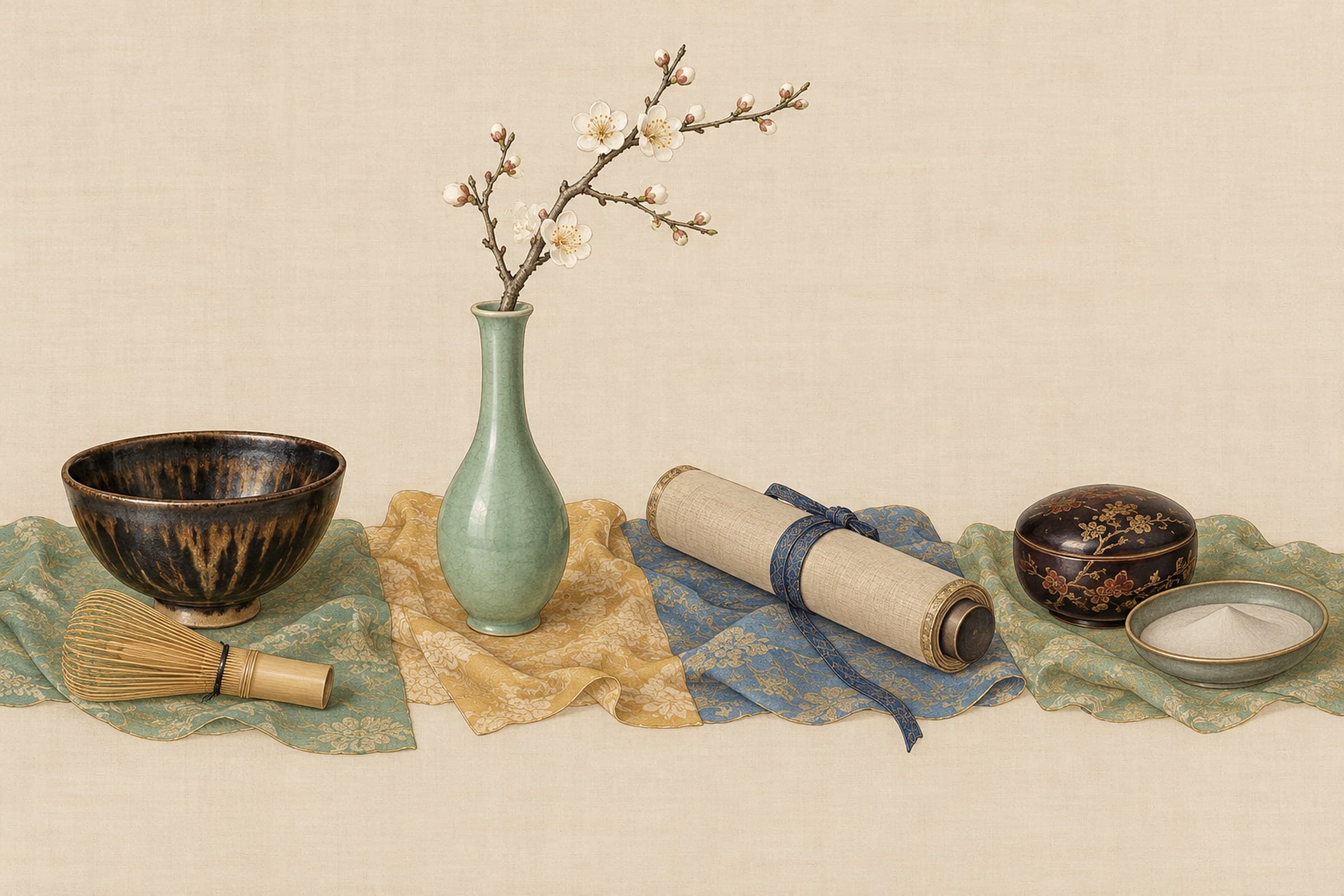
Burning incense, making tea, hanging paintings and arranging flowers are often called the four arts of Song-dynasty life. The line comes from a memoir of Hangzhou, the Southern Song capital. In its original setting it is advice about banquets: the four tasks look leisurely, but you should hire someone who knows how to do them.
Where the line comes from
Wu Zimu of Qiantang wrote the Mengliang lu 夢粱錄 looking back on Hangzhou. Its nineteenth volume describes the “four offices and six bureaus” that could be hired for a banquet. Government offices used them for their spring banquets and for the feast held for successful examination candidates. Wealthy families and ordinary townspeople hired the same staff for weddings and funerals, and “everything could be made complete”.
Each office had its tasks. The hangings office put up the ceiling cloths, table skirts, curtains and screens, and the scrolls of calligraphy and painting. The tea-and-wine office served tea, poured wine, seated the guests and called out the greetings. There was a kitchen, an office for the serving trays, and bureaus for fruit, candied fruit, vegetables, lamps and candles, and the furniture and sweeping.
Who looked after the incense
One bureau handled incense and medicines. It kept the ambergris, agarwood and borneol and other rare incenses, the incense stands, censers and incense balls, and it set the incense on fine ash. Its staff listened for the moment the incense needed changing. After the wine, they brought hangover soups and medicinal cakes when asked.
The saying
Then Wu Zimu quotes a common saying: “Burning incense, making tea, hanging paintings, arranging flowers: four leisurely tasks, not to be left to amateurs.” If anything went wrong at a banquet, he adds, it was because the staff were not skilled. His word for amateurs, lijia 戾家, means people from outside a trade.
He also records the order in which the staff were rewarded at a banquet: the tea-and-wine office first, the kitchen second, the musicians third, the bureaus fourth and the host’s own servants last. It is a small matter, he writes, but he notes it down.
Why it is remembered as the four arts
Read today, the four tasks sound like a scholar’s pastimes, and they are often presented that way. The memoir shows them as skilled work: at a Hangzhou banquet, someone was paid to watch the incense. Both readings agree on one thing. In Song Hangzhou, incense sat beside tea, paintings and flowers in the way a room was made ready for guests.
Incense you wear
The incense in the memoir is burned. People also wore it, as scented beads: see Hexiang: blended incense, worn as beads. Our bracelets are hexiang shaped into beads, and the materials register lists what is in each one. Our beads aren’t made to the recipes in the old registers.
Sources
- Wu Zimu, Mengliang lu 夢粱錄, volume 19 (四司六局筵會假賃).