The Chinese incense ball: a burner that could roll in the bed
Warm wood and resin, the green, rooty edge of chuanxiong, a little rose and a soft ambergris accord: that is Elegant Orchid & Ambergris on the wrist. A scented bead keeps its scent close to the skin with no fire and no heat, and it lasts for years.
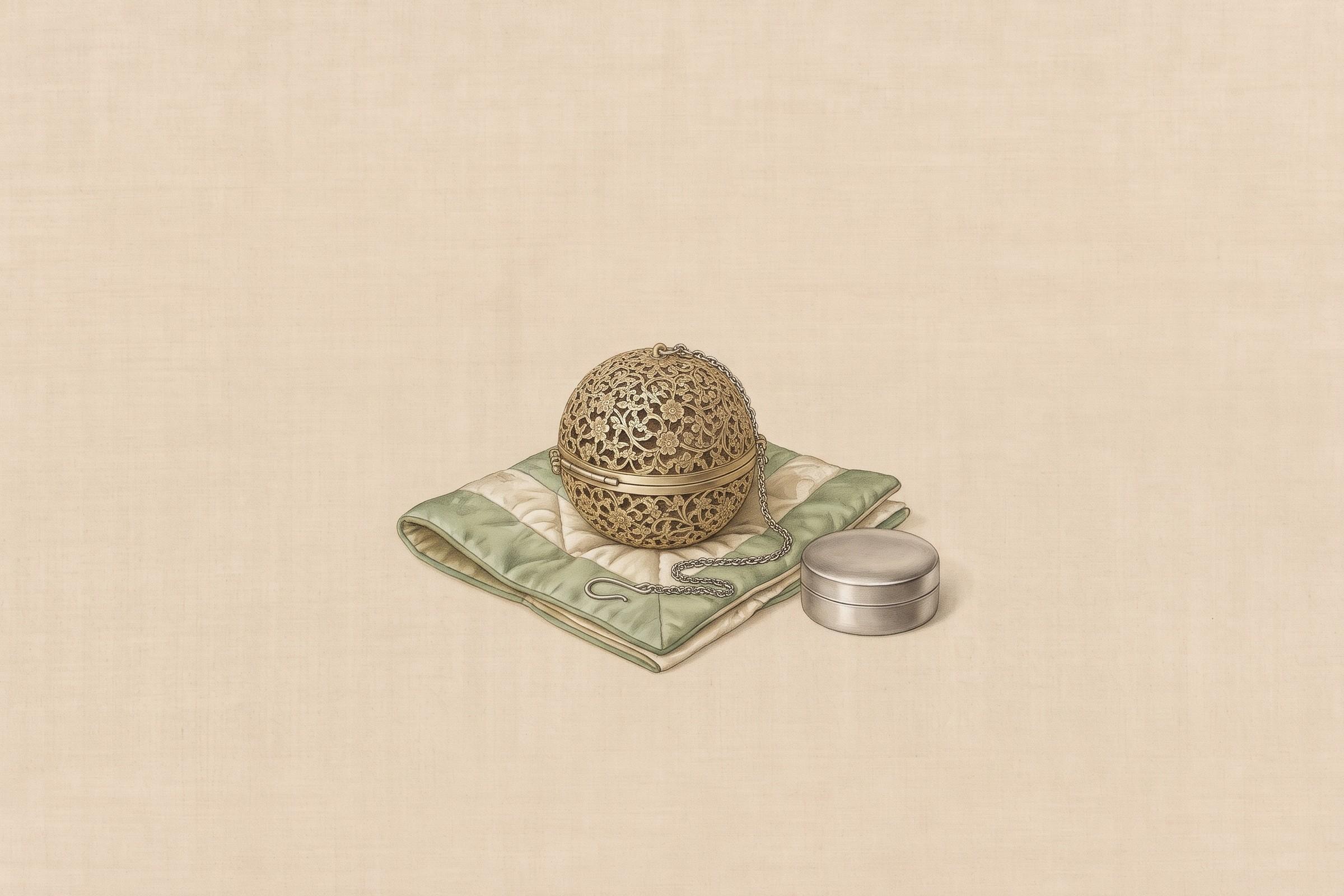
Before scented beads, scent worn that close came from a pouch of dry powder, or from a fire. A craftsman of Chang’an named Ding Huan made a burner that could be put inside the bedclothes: a pierced ball with rings inside that kept the burning incense level however it rolled. Later it was called the incense ball, xiangqiu 香毬.
The burner for inside the quilt
The story is told in Miscellaneous Records of the Western Capital 西京雜記, a book of anecdotes about Han-dynasty Chang’an put together around the fourth century. Its first volume says that Ding Huan made a lamp that never ran dry, and then:
He also made a burner for the bedding, also called the burner inside the quilt. It first came from Fang Feng, but the method was later lost, until Ding Huan made it again. He made rings on pivots that turn all the way round, while the body of the burner always stays level, so that it can be put among the bedclothes. Hence the name.
The same book has Ding Huan building a palace hall for an emperor’s favourite, and calls him the most skilled craftsman under heaven. Of Fang Feng, nothing else is known.
How it stays level
An incense ball has three parts. The outside is a pierced shell in two halves, hinged on one side so it can be opened. Inside are two rings, one within the other. Each ring turns on a pair of pivots, and the second pair is set at right angles to the first. At the centre hangs a small cup that holds a lit ember and a pinch of incense.
The cup is weighted at the bottom, so it always swings down. When the ball rolls, the rings turn around the cup and the cup stays upright. The ember stays in the cup, and the pierced shell lets the smoke out while it keeps the fire off the cloth.
The same arrangement holds a ship’s compass steady, and in English it is called a gimbal. In Europe it is also named after Gerolamo Cardano, the sixteenth-century Italian who described it in detail. He did not invent it, nor did he claim to. A Greek engineer, Philo of Byzantium, describes something like it in the third century BC, though some doubt that the passage is his. The oldest Chinese incense balls that survive are from the Tang dynasty.
A Tang ball in silver
The Metropolitan Museum of Art in New York has one, made of silver in the eighth or ninth century. It is 6 centimetres across, a little smaller than a tennis ball. Leafy scrolls are cut right through the silver, the two halves meet at a plain band with a hinge pin at the side, and a small loop at the top would have held a chain.
The poet Yuan Zhen (779–831) wrote four lines about one, called simply Incense Ball:
It goes along with the world, only rolling round; at its centre, nothing stirs.
The poem ends by marvelling that its fire burns so long.
Incense balls in Song streets
By the Song dynasty the name had changed. Chen’s Incense Register, finished by 1322, copies Ding Huan’s story in its fourth volume and adds one line: “that is today’s incense ball”. At banquets in Song Hangzhou, the bureau that looked after the incense kept “censers and incense balls” with its rare incenses, as told in The four leisurely arts.
The poet Lu You (1125–1210) wrote down how the capital, Kaifeng, had been before it fell in 1127:
In the capital, in the years of peace, the imperial clan and the emperor’s in-laws went into the palace at the festivals. When the women climbed into their ox carts, two little maids held incense balls beside each of them, and in their sleeves they carried two small incense balls of their own. As the carts went by, the smoke rose like clouds, unbroken for a mile or two, and even the dust was fragrant.
What burned inside
The register never says which incense went into a ball. It does have a recipe named Incense Ball in its second volume: stone lichen and tree moss, “the green coat on pine trees”, with jujube flesh, agarwood, snail lid (the lid that closes a sea snail’s shell), borneol and musk, made into a paste with jujube and a little honey, pressed into small cakes and “burned in the usual way”. The usual way was a cake set over a buried ember, as described in How the Song burned incense.
The recipe before it, Treasure Ball 寶毬香, is named for its smoke, which “rises straight up like a thread and knots into the shape of a ball, holding a long time without scattering”.
Scent for the bed curtains
The bed was where people wanted scent most. The register’s fourth volume also tells of warm winter bed curtains with pierced gold and silver censers fixed at their four corners. A ballad from the end of the Han lists a canopy with scent pouches hanging from its corners, in Did people in ancient China wear scent? And our Goose-Pear Canopy is named for a Southern Tang incense made for inside the bed curtains.
Our beads carry scent the same short distance, without the ember. They are made from powdered materials, like the old incense cakes, but nothing in them burns. More on how in What is hexiang?
Questions
Did the incense ball set the bedding on fire? That is what the rings were for. The cup stays upright, so the ember and the incense stay in it, and the pierced shell keeps them off the cloth. Still, it held a live ember.
Was the gimbal invented in China? It was known in China early. The story of Ding Huan places it in the Han dynasty, and Tang incense balls survive. A Greek description may be older still. Europe named it after Cardano, who wrote about it in the sixteenth century.
What is the difference between an incense ball and a scent pouch? An incense ball burns its incense, so it gives smoke and needs an ember. A scent pouch holds dry powdered materials and gives scent with no fire. Scented beads work like the pouch.
Where can you see a Chinese incense ball? The Tang silver ball in the Metropolitan Museum of Art in New York is described above, and its online collection has photographs of it.
Can you wear a scented bracelet to bed? Yes. Nothing in the beads burns. Keep them dry: take the bracelet off before washing your hands, bathing or swimming.
How long does the scent of a bead last? For years.
How the Song burned incense: charcoal, ash and mica
Sources
- Xijing zaji 西京雜記, volume 1 (常滿燈 被中香爐; 昭陽殿).
- Chen Jing, Chenshi xiangpu 陳氏香譜, volume 2 (寶毬香, 香毬) and volume 4 (被中香爐, 帳角香爐).
- Yuan Zhen, 香毬, in Yuanshi changqing ji 元氏長慶集, volume 15.
- Lu You, Laoxue’an biji 老學庵筆記, volume 1.
- The Metropolitan Museum of Art, Censer, China, Tang dynasty, 8th–9th century, silver, 21.146.
- Wikipedia, Gimbal.